Hybrid

Medical Office Administration

Academic Department
Editorial Section
Program Levels
Program Location
Program Types
Sort Name
Medical Office Administration
Summary

Medical Office Administration prepares you to manage the administrative and clinical side of a healthcare setting. You will learn how to handle patient records, manage schedules, and communicate clearly with doctors, nurses, and patients. The program covers health data management, medical terminology, and the ethics and laws that protect patient privacy. You will also practice technical report writing and digital media tools used in modern health offices. Because the program is delivered in a hybrid format, you will work on some assignments online and meet on campus for hands-on labs and group projects.

Career outcomes

  • Medical office administrator
  • Health records coordinator
  • Clinical receptionist
  • Patient services representative
  • Healthcare administrative assistant
  • Medical office supervisor

Admission requirements

  • Ontario Secondary School Diploma (OSSD) or equivalent
  • Grade 12 English (C or U) with a minimum grade of 60%
  • Mature student status (19 or older by the start of classes) is accepted

Tuition

2024–25 tuition: $3,390 per year (domestic)

Courses

What you will learn

Medical Office Administration prepares you to manage the administrative and clinical side of a healthcare setting. You will learn how to handle patient records, manage schedules, and communicate clearly with doctors, nurses, and patients. The program covers health data management, medical terminology, and the ethics and laws that protect patient privacy. You will also practice technical report writing and digital media tools used in modern health offices. Because the program is delivered in a hybrid format, you will work on some assignments online and meet on campus for hands-on labs and group projects. You will gain confidence in using database systems, managing appointments, and supporting clinical staff behind the scenes.

How the program runs

This Ontario College Diploma takes two years to complete and includes four terms. You can start in September or January. The program is based at the Mercer Street Campus, which is in downtown Wrenford. Classes are held in the Mill Building and the Market Square Studios, where you will use real-world software for health records and office management. You will complete 13 courses, including foundations in mathematics, health sciences, and professional communication. The hybrid schedule is designed to give you flexibility while still providing the face-to-face practice you need for client service and clinical support roles.

Admission

To join the program, you must hold an Ontario Secondary School Diploma (OSSD) or an equivalent qualification. You will need Grade 12 English at the college or university preparation level with a minimum grade of 60%. If you are 19 or older by the start of classes, you may apply as a mature student. The program runs on a hybrid delivery model, so you will need reliable internet access and a quiet workspace for online sessions. All students must follow the college's code of conduct and privacy rules when handling simulated patient data.

Tuition and fees

The cost of this program is set for the 2024–25 academic year. 2024–25 tuition: $3,390 per year (domestic). This fee covers your instruction, use of campus computers, and access to the library. You will also pay annual ancillary fees for services like student health and dental plans, the campus store, and athletics. Payment plans are available through Student Financial Aid, and you may be eligible for fee waivers or provincial student financial assistance if you qualify.

After you graduate

Graduates of the Medical Office Administration program are ready to work in doctors' offices, clinics, hospitals, and community health centres. You will take on roles such as medical office administrator, health records coordinator, clinical receptionist, patient services representative, and healthcare administrative assistant. Employers value your ability to manage electronic health records, handle confidential information, and provide a welcoming experience for patients. The skills you build in this program also prepare you for further study in health administration or business management.

How to apply

You can apply to this program through the provincial college application service. Select Medical Office Administration and choose your preferred intake term. If you are applying as an international student, use the polytechnic's own application form. You will need to upload your transcripts and any required test scores to myWrenford. Once you receive an offer, accept it in the portal and pay your tuition deposit to secure your seat. For questions about admission, contact the Admissions office at 519-555-0171 or visit the How to apply page.

GIS & Remote Sensing

Academic Department
Program Levels
Program Location
Program Types
Sort Name
GIS & Remote Sensing
Summary

This program prepares you to work with geospatial data in fields like environmental monitoring, urban planning, and transportation. You will learn how to capture data from satellites and mobile devices, process it using industry-standard software, and turn it into clear maps and reports that solve real-world problems.

Career outcomes

  • Geospatial Analyst
  • GIS Technician
  • Remote Sensing Specialist
  • Cartographer
  • Mapping Systems Coordinator
  • Urban Data Analyst

Admission requirements

  • Ontario College Diploma or Advanced Diploma in Geomatics, Geography, Environmental Science, or a closely related field.
  • Grade 12 Mathematics (C or U) with a minimum grade of 60%.
  • Grade 12 English (C or U), minimum 60%; international applicants must provide an English proficiency test score or equivalent.
  • Resume and a letter of explanation outlining your interest in geospatial technology.

Tuition

Domestic tuition for the 2026–27 academic year is $4,680 per year, plus $1,125 in ancillary fees.

Courses

What you will learn

You will spend the year building practical skills in geospatial data collection, processing, and analysis. The program covers the full workflow from capturing raw data using satellite imagery and mobile mapping systems to cleaning, storing, and visualising it in geographic information systems (GIS). You will work with both vector and raster data, learn to design accurate maps, and use spatial analysis to find patterns in complex datasets. The curriculum also introduces you to geospatial web services, 3D visualisation, and data mining techniques that are standard in the industry.

Classes combine theoretical concepts with hands-on labs in the Kingfisher Building. You will use the same software and hardware that employers rely on, so you can step into a professional role with confidence. Throughout the program, you will complete projects that mirror real client requests, giving you a portfolio of work to show potential employers.

How the program runs

The program runs over two terms in the 2026–27 academic year, starting in September. Because the schedule is hybrid, you will attend some in-person sessions at the Benchlands Campus while completing other coursework online. This mix allows you to balance your studies with work or family commitments while still getting access to the college's mapping labs and technical support.

Classes are held in the Kingfisher Building on the Benchlands Campus. The Benchlands Campus is served by Wrenford Transit routes 3 and 7, which stop at the Hollis Hall loop. There are several student parking lots on campus, including Lot B and Lot D, though the visitor lot requires a plate. You will need a computer with a stable internet connection to participate in the online portions of the program.

This graduate certificate does not include a co-op work term. However, the College's Co-op & Career Services office runs workshops and job fairs that are open to all students, helping you build your resume and connect with employers in the geospatial sector.

Admission

To apply, you must meet the standard admission requirements for graduate certificates at Wrenford Polytechnic. This includes an Ontario College Diploma or Advanced Diploma in a related field, or equivalent post-secondary coursework. You must have completed Grade 12 Mathematics (C or U) with a minimum grade of 60%, and Grade 12 English (C or U) with a minimum grade of 60%. International applicants must also provide proof of English proficiency through an accepted test or equivalent academic background.

Domestic applicants apply through the provincial college application service. International applicants use the College's own application form. The application deadline for equal consideration in the fall term is March 1, 2027.

Tuition and fees

Domestic tuition for the 2026–27 academic year is $4,680. This covers two terms of instruction and access to all program labs and online learning platforms. You will also pay $1,125 in ancillary fees, which support student services, the library, and campus facilities. There is no application fee to submit your application.

If you need to spread out your tuition payments, you can request a tuition payment plan through Student Financial Aid. International students should check the International Students page for currency exchange guidelines and required deposit information.

After you graduate

Graduates of the GIS & Remote Sensing program are ready to work as geospatial analysts, mapping technicians, or data coordinators in sectors like environmental consulting, municipal planning, agriculture, and logistics. The program's focus on current satellite systems and mobile mapping means you will have the technical skills that employers are actively seeking.

Many graduates find employment through the College's Co-op & Career Services network, but some also secure roles directly through project partnerships built during the program. The skills you develop here are transferable, so you can also move into roles in data science, urban planning, or environmental management with a little additional on-the-job training.

How to apply

Ready to apply? Visit the How to apply page to review the full application steps, upload your documents, and track your application status. If you have questions about the program, contact the Civil Engineering & Geomatics department at 519-555-0170, ext. 4310, or email the admissions office at [email protected].

Data Analytics

Program Levels
Program Types
Sort Name
Data Analytics
Summary

This program builds on your existing post-secondary education to give you practical skills in data analytics and machine learning. You will learn how to gather raw data, prepare it for analysis, and turn it into clear visual reports that guide business decisions. Through hands-on projects, you will work with real-world datasets to solve practical problems.

Career outcomes

  • Data Analyst
  • Business Intelligence Analyst
  • Machine Learning Specialist
  • Data Visualization Developer
  • Analytics Consultant
  • Research Data Coordinator

Admission requirements

  • Completed Ontario College Diploma, Ontario College Advanced Diploma, or bachelor's degree from a recognized institution.
  • Grade 12 Mathematics (C or U) with a minimum of 60%.
  • English proficiency test or equivalent for international applicants.
  • Prerequisite course in statistics or business math, or equivalent experience.

Tuition

Domestic tuition is $4,680 per year for the 2026–27 academic year.

Courses

What you will learn

In this program, you will move past basic data entry and learn how to manage large datasets from start to finish. You will explore how to clean and organize information so it is accurate and ready for analysis. You will build predictive models that help forecast trends and identify risks before they happen. You will also learn how to present complex numbers in simple charts and dashboards that decision-makers can understand. The curriculum covers data governance, meaning you will learn how to keep data secure and compliant with privacy standards while working with it.

How the program runs

This program is delivered in a hybrid format, mixing on-campus labs with online coursework so you can manage your schedule. You can start in September or January, and you will complete the program over two or three terms. Classes are held across both the Benchlands Campus and the Mercer Street Campus, giving you access to the computing labs at both locations. You will work on group projects and individual case studies, using industry-standard software to build your portfolio. There is no co-op work term built into this program, but you will complete a final capstone project that simulates a real business environment.

Admission

To join the program, you must hold a completed college diploma, advanced diploma, or university degree. You will need to show proof of Grade 12 Mathematics at a 60% level or higher, or complete an approved college-level statistics course before you start. International applicants must submit an approved English proficiency test score. We review every application as it comes in, so we recommend submitting your documents early. If you have relevant work experience in data or analytics, you may be able to request a Prior Learning Assessment and Recognition (PLAR) to waive certain prerequisites.

Tuition and fees

Domestic tuition is $4,680 per year for the 2026–27 academic year. This covers your classes and standard campus services. You will also pay ancillary fees of $1,125 per year, which support the library, fitness centre, and student association. You can pay your tuition in two equal payments, one before the fall term starts and one before the winter term. If you need help covering costs, you can apply for provincial student financial assistance or ask about tuition payment plans through Student Financial Aid.

After you graduate

Graduates leave with a strong portfolio of data visualizations and predictive models that you can show to employers. You will be ready to step into roles that require both technical analysis and clear communication. Many of our alumni work in sectors like healthcare, manufacturing, retail, and financial services, where data-driven decisions are essential. You will also have the foundation to continue into advanced graduate certificates or applied bachelor's degrees if you wish to keep studying.

How to apply

Domestic applicants apply through the provincial college application service. International applicants register directly on the polytechnic's own form. You will need to upload your official transcripts and identification documents to your student portal once you receive an admission offer. Visit the Apply page for full instructions and important deadlines. If you have questions about the admission process, contact Admissions at 519-555-0171.

Cybersecurity

Program Levels
Program Location
Program Types
Sort Name
Cybersecurity
Summary

This Ontario College Graduate Certificate prepares you to identify, assess and mitigate security risks in digital environments. You will work with the tools and protocols that organisations use to defend against cyber threats, respond to incidents and maintain compliance with security standards.

Career outcomes

  • Security Analyst
  • Network Security Administrator
  • Incident Response Specialist
  • Compliance Auditor
  • Penetration Tester
  • IT Security Consultant

Admission requirements

  • Ontario Secondary School Diploma (OSSD) or equivalent, or mature student status (19 or older by the start of classes).
  • Grade 12 English (C or U), minimum 60%.
  • International applicants: English proficiency test or equivalent.
  • A basic understanding of IT concepts is recommended.

Tuition

Domestic tuition for the 2026–27 academic year is $4,680. Ancillary fees of $1,125 apply per year.

Courses

What you will learn

In this program, you will study how to protect digital systems and sensitive data from unauthorised access. You will learn to monitor networks for unusual activity, analyse security logs and put in place strong controls to keep information safe. The curriculum covers the main models that govern how networks operate, the encryption methods that keep data private and the frameworks that guide risk management. You will also practise how to respond to security incidents and build disaster recovery plans so an organisation can keep running after a breach.

How the program runs

You will study at the Benchlands Campus through a hybrid schedule that mixes online learning with in-person labs and workshops. The program runs for one year across two to three terms. You can start in September or January. Classes are designed for working professionals and recent graduates, so the timetable allows you to balance your studies with other commitments. You will work in the Kingfisher Building, where the Computing & Information Technology department houses its computer labs and testing rooms.

Admission

To join this program, you must hold an Ontario Secondary School Diploma (OSSD) or an equivalent qualification, or meet mature student status (19 or older before classes begin). You need Grade 12 English (C or U) with a minimum grade of 60%. International applicants must provide proof of English proficiency through a recognised test or equivalent study. A foundational understanding of IT concepts is recommended before you start. If you need to strengthen your English or math skills, you can explore upgrading options through the Academic Upgrading centre.

Tuition and fees

Domestic tuition for the 2026–27 academic year is $4,680. This covers your two to three terms of study. You will also pay ancillary fees of $1,125 per year for campus services, technology access and student association membership. These fees are separate from tuition. If you require financial support, you can contact Student Financial Aid to discuss eligibility for provincial student assistance, in-house bursaries and entrance scholarships. The polytechnic does not charge an application fee.

After you graduate

Graduates are prepared to step into roles that protect organisational infrastructure and data. Employers in the City of Wrenford and across Ontario hire graduates to manage security operations, conduct compliance audits and lead incident response teams. You will leave the program with a portfolio of lab reports and risk assessments that demonstrate your ability to secure networks and defend against cyber threats. You can also speak with staff at Co-op & Career Services to explore employment opportunities and professional development.

How to apply

Domestic applicants submit their application through the provincial college application service. International applicants use the polytechnic's own application form. You can upload your transcripts and supporting documents through the myWrenford portal once your application is started. Make sure to check the Tuition and fees page for payment deadlines and the How to apply page for step-by-step instructions. If you have questions about admission or course transfers, visit Future Students or contact the Computing & Information Technology department.

Allied Health & Wellness

Compact Name
Allied Health
Editorial Section
Program Type
Sort Name
Allied Health & Wellness
Summary

Explore health and wellness programs led by Chair Chloé Bergeron, covering pharmacy, fitness, patient care, and medical administration.

About the department

The Allied Health & Wellness department under the School of Health Sciences prepares you for careers that support patient care, community health, and medical operations. You will study subjects tagged HLTH, KINE, and PHAR while building the practical skills employers look for. Our faculty members bring real-world experience into the classroom so you can apply what you learn from day one.

Programs

  • Pharmacy Technician — Ontario College Diploma. Learn to dispense medications, manage inventory, and work with healthcare teams in retail and hospital settings.
  • Personal Support Worker — Ontario College Certificate. Develop hands-on skills to assist clients with daily living activities in community and care home environments.
  • Fitness & Health Promotion — Ontario College Diploma. Design and lead wellness programs, conduct fitness assessments, and promote healthy lifestyles in diverse community settings.
  • Occupational Therapist & Physiotherapist Assistant — Ontario College Diploma. Support registered therapists in rehabilitation settings by preparing treatment rooms, assisting with exercises, and maintaining client records.
  • Medical Office Administration — Ontario College Diploma. Manage clinical schedules, handle medical documentation, and support healthcare providers in fast-paced medical environments.

Facilities and labs

All Allied Health & Wellness programs are based in Corvid Hall on the Benchlands Campus. You will use our dedicated simulation centre to practice clinical scenarios, patient communication, and emergency response in a safe, supervised environment. The building also houses standard classroom spaces and computer labs equipped with the software you will use in your future workplaces.

Department chair

Chloé Bergeron leads the department and oversees curriculum development, faculty mentoring, and industry partnerships. You can reach the department office during regular business hours.

Contact

Department office: Corvid Hall, Room 208
Phone: 519-555-0170, ext. 3302
Hours: Monday to Friday, 8:30 a.m. to 4:30 p.m.

For admission requirements and program details, visit Admissions. Check Tuition & Fees for current tuition and ancillary fee information. Learn about work-integrated learning opportunities through Co-op & Career Services.

Thumbnail
Image
In a polytechnic, a pharmacy-technician student counting tablets with a tray and spatula

Civil Engineering & Geomatics

Compact Name
Civil Engineering
Program Type
Sort Name
Civil Engineering & Geomatics
Summary

Prepare for careers in civil infrastructure, land surveying, and geographic information systems through hands-on programs and modern lab work.

About the department

The Civil Engineering & Geomatics department prepares students for careers in civil infrastructure, land surveying, and geographic information systems. You will work through hands-on projects that mirror real industry challenges, using the latest design and mapping tools. The department is led by Chair Nadia Benali.

Programs

Facilities and labs

Students in the department use the Kingfisher Building for computer-aided design work and data analysis. Field surveys and mapping exercises take place at the Escarpment Building and the campus outdoor lab spaces. All students also have access to the Falls Library & Learning Commons for research and study.

How to reach us

The department office is in Room 212 of the Kingfisher Building. You can call the department at 519-555-0170, ext. 4301. For questions about admissions, visit the Admissions page or call 519-555-0171.

Thumbnail
Image
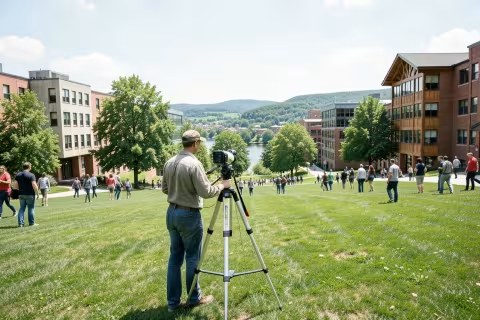
In a polytechnic, a surveying student behind a tripod-mounted instrument on a campus lawn

Computing & Information Technology

Compact Name
Computing
Program Type
Sort Name
Computing & Information Technology
Summary

The Computing & Information Technology department delivers programs in computing, networking, and cybersecurity from the Benchlands Campus.

The Computing & Information Technology department prepares students for careers in software development, systems administration, networking, and cybersecurity. Offering the subject codes COMP, NETW, and CYBR, the department sits within the School of Computing & Academic Studies on the Benchlands Campus. Students work in modern computer labs located in the Kingfisher Building, where they gain hands-on experience with industry-standard hardware, cloud platforms, and security tools.

Programs

Current programs in the department include Computer Systems Technology, Computer Systems Technology (Part-time), Network & Cloud Administration, Cybersecurity, Data Analytics, and Bachelor of Applied Technology — Software Development. Each program is designed to match the pace of the technology sector, with options for full-time, part-time, hybrid, and online delivery.

Department leadership

The department is led by Chair Anjali Deshmukh, who oversees curriculum development, faculty, and industry partnerships. Students can reach the department office by calling 519-555-0170, ext. 3100, or by visiting during office hours, Monday to Friday, 8:30 a.m. to 4:30 p.m.

Thumbnail
Image
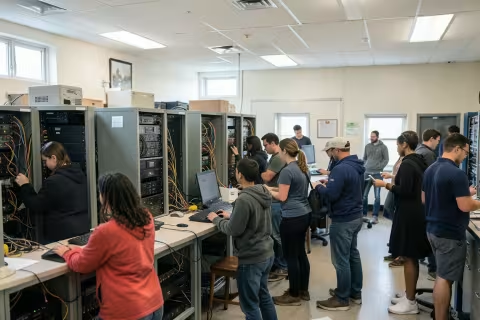
In a polytechnic, students racking network equipment in a server-room training lab