Full-time

Electrical & Mechanical Trades

Compact Name
Electrical
Program Type
Sort Name
Electrical & Mechanical Trades
Summary

The Electrical & Mechanical Trades department offers hands-on training in electrical techniques, industrial mechanics, and welding at the Benchlands Campus.

About the department

The Electrical & Mechanical Trades department prepares you for hands-on careers in skilled trades. You will work with industry-standard tools and machinery in our fully equipped workshops at the Tamarack Building on the Benchlands Campus. Our programs cover electrical installation, machining, welding, and fabrication.

Programs and subjects

Our curriculum covers three main subject areas: electrical techniques (ELTR), industrial mechanics (MILL), and welding (WELD). You can study these subjects through a range of programs, including certificates, diplomas, and apprenticeship training. Explore our program pages to see how these subjects fit into your career path.

Facilities and labs

Students in this department spend much of their time in the Tamarack Building. The building houses dedicated welding bays, machine shops, and electrical labs where you will practice safe work habits and build practical skills. Before entering the shops, you must complete our shop safety orientation. You must be 16 or older to work in the shops; students under 18 need a signed consent form.

Contact the department

The department is led by Chair Bronwyn Pryce. For questions about programs, prerequisites, or apprenticeship registration, contact the department office during business hours. We welcome prospective students to ask about course outlines, tools lists, and next steps.

Phone: 519-555-0170, ext. 4305
Email: [email protected]
Thumbnail
Image
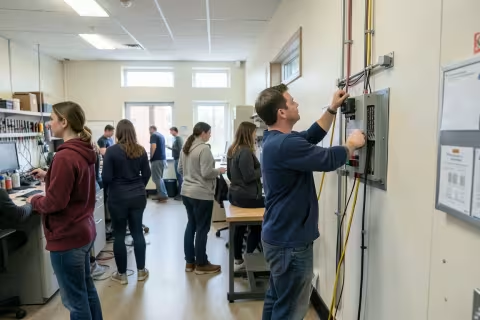
In a polytechnic, an electrical apprentice pulling cable through conduit on a training wall

Carpentry & Construction Trades

Compact Name
Carpentry
Program Type
Sort Name
Carpentry & Construction Trades
Summary

Learn carpentry and plumbing trades at Wrenford Polytechnic's Benchlands Campus under the guidance of Chair Tomasz Zielinski.

About the department

Welcome to the Carpentry & Construction Trades department at Wrenford Polytechnic. You will learn to build, repair, and maintain structures using wood, steel, and other materials. Our programs prepare you for a career as a carpenter or plumber, whether you want to work for a contractor, start your own business, or join a large construction firm. You will spend most of your time in our large, fully equipped shops to support and apply the theory you learn in class.

Programs

We offer programs that cover both carpentry and plumbing trades. You can choose from a certificate in carpentry and renovation techniques, or begin your apprenticeship training in general carpentry or plumbing. All programs are delivered on the Benchlands Campus and include hands-on shop work.

Key programs

  • Carpentry & Renovation Techniques (Certificate)
  • General Carpenter (Apprenticeship)
  • Plumber (Apprenticeship)

Facilities & shops

Your training takes place in the Tamarack Building on the Benchlands Campus. You will work in our large shops and welding bays, where you will practice cutting, joining, and assembling materials. The department office is located in Room 104 of the Tamarack Building.

Meet the chair

The department is led by Chair Tomasz Zielinski. He brings years of hands-on experience in the construction trades and is dedicated to helping students succeed in their training. He works closely with faculty to ensure the curriculum matches industry standards.

Contact us

If you have questions about the program, apprenticeship registration, or funding, contact the department office. You can call the main line and ask for the Carpentry & Construction Trades office at extension 4201. Office hours are Monday to Friday, 8:30 a.m. to 4:30 p.m.

Shop safety & access

You must be 16 or older to enter the shops. Students under 18 need a signed consent form. Always follow the safety rules posted in the Tamarack Building and wear the required personal protective equipment at all times.

Thumbnail
Image
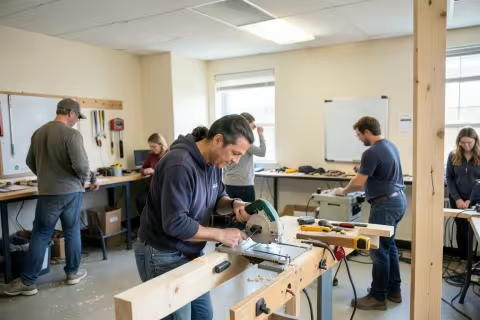
In a polytechnic, a carpentry apprentice cutting a stud with a mitre saw

Allied Health & Wellness

Compact Name
Allied Health
Editorial Section
Program Type
Sort Name
Allied Health & Wellness
Summary

Explore health and wellness programs led by Chair Chloé Bergeron, covering pharmacy, fitness, patient care, and medical administration.

About the department

The Allied Health & Wellness department under the School of Health Sciences prepares you for careers that support patient care, community health, and medical operations. You will study subjects tagged HLTH, KINE, and PHAR while building the practical skills employers look for. Our faculty members bring real-world experience into the classroom so you can apply what you learn from day one.

Programs

  • Pharmacy Technician — Ontario College Diploma. Learn to dispense medications, manage inventory, and work with healthcare teams in retail and hospital settings.
  • Personal Support Worker — Ontario College Certificate. Develop hands-on skills to assist clients with daily living activities in community and care home environments.
  • Fitness & Health Promotion — Ontario College Diploma. Design and lead wellness programs, conduct fitness assessments, and promote healthy lifestyles in diverse community settings.
  • Occupational Therapist & Physiotherapist Assistant — Ontario College Diploma. Support registered therapists in rehabilitation settings by preparing treatment rooms, assisting with exercises, and maintaining client records.
  • Medical Office Administration — Ontario College Diploma. Manage clinical schedules, handle medical documentation, and support healthcare providers in fast-paced medical environments.

Facilities and labs

All Allied Health & Wellness programs are based in Corvid Hall on the Benchlands Campus. You will use our dedicated simulation centre to practice clinical scenarios, patient communication, and emergency response in a safe, supervised environment. The building also houses standard classroom spaces and computer labs equipped with the software you will use in your future workplaces.

Department chair

Chloé Bergeron leads the department and oversees curriculum development, faculty mentoring, and industry partnerships. You can reach the department office during regular business hours.

Contact

Department office: Corvid Hall, Room 208
Phone: 519-555-0170, ext. 3302
Hours: Monday to Friday, 8:30 a.m. to 4:30 p.m.

For admission requirements and program details, visit Admissions. Check Tuition & Fees for current tuition and ancillary fee information. Learn about work-integrated learning opportunities through Co-op & Career Services.

Thumbnail
Image
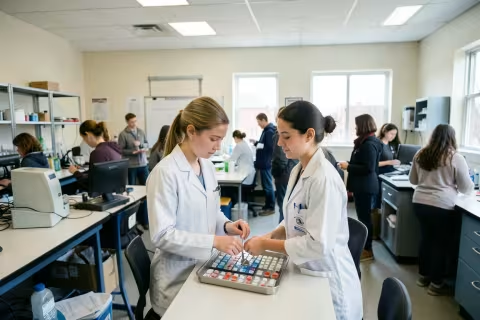
In a polytechnic, a pharmacy-technician student counting tablets with a tray and spatula

Diagnostic & Laboratory Sciences

Compact Name
Diagnostic
Editorial Section
Program Type
Sort Name
Diagnostic & Laboratory Sciences
Summary

The Diagnostic & Laboratory Sciences department delivers hands-on training for medical laboratory and radiation technology careers.

About the department

The Diagnostic & Laboratory Sciences department covers the DLAB and MRAD subjects. You will learn how to analyse biological samples, operate advanced imaging equipment, and follow strict infection control protocols. Our courses blend classroom theory with supervised lab practice so you can enter a clinical setting ready to work.

Programs

Two full-time programs run through this department:

  • Medical Laboratory Technology — a three-year advanced diploma covering haematology, microbiology, chemistry and blood banking.
  • Medical Radiation Technology — a three-year advanced diploma covering diagnostic radiography, computed tomography, magnetic resonance imaging and radiation therapy.

Labs and facilities

Practical training happens in the simulation centre and specialist labs inside Corvid Hall (CH). You will use modern diagnostic equipment, practice sample collection and handling, and complete clinical placements at regional hospitals. All labs follow provincial health and safety rules. You must be 16 or older to enter the shops and labs; students under 18 need a signed consent form.

Department chair and contact

The department is led by Chair Samuel Abara. For questions about course scheduling, program prerequisites or lab safety requirements, contact the department office in Corvid Hall, Room 210. You can reach the office at 519-555-0170, ext. 4300. Office hours are Monday to Friday, 8:30 a.m. to 4:30 p.m.

Thumbnail
Image
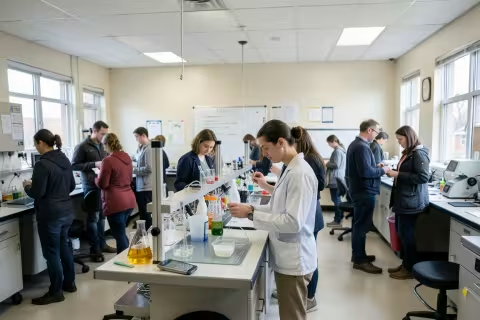
In a polytechnic, a medical-laboratory student pipetting samples at a clean bench

Nursing

Compact Name
Nursing
Editorial Section
Program Type
Sort Name
Nursing
Summary

The Nursing department prepares students for careers in patient care through the Bachelor of Science in Nursing and Practical Nursing programs.

About Nursing

The Nursing department within the School of Health Sciences prepares you for a career in patient care across hospitals, community clinics, and long-term care facilities. Under the leadership of Department Chair Margaret Ellison, our program blends classroom learning with hands-on clinical practice. You will study alongside faculty members who bring real-world experience to every lesson.

Training Facilities

Most of your training takes place on the Benchlands Campus in Corvid Hall. Our simulation centre is equipped with high-fidelity mannequins and patient care tools so you can practice essential skills in a safe, supervised environment. These labs allow you to build confidence and learn from guided feedback before you begin your clinical placements in local healthcare settings.

Programs

The department oversees three programs designed to meet different career goals. The Bachelor of Science in Nursing (collaborative) is a four-year degree that prepares you to write the national licensing exam and work as a registered nurse. The Practical Nursing diploma is a two-year full-time program, and the Practical Nursing (Part-time) option allows working students to complete the same credential on a flexible schedule. All programs prepare you for entry-level practice as a licensed practical nurse or registered nurse.

Contact the Department

Visit the department office in Corvid Hall, Room 205, or call 519-555-0170, ext. 3300. The office is open Monday to Friday, 8:30 a.m. to 4:30 p.m.

Thumbnail
Image
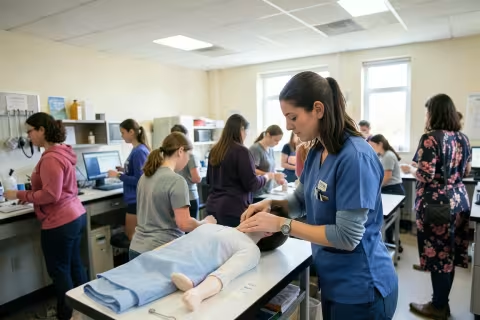
In a polytechnic, a nursing instructor coaching a student taking a mannequin's blood pressure

Power & Process Engineering

Compact Name
Power
Program Type
Sort Name
Power & Process Engineering
Summary

Power & Process Engineering delivers certificate, diploma, and graduate certificate programs focused on power generation, chemical processing, and renewable energy systems.

About the department

The Power & Process Engineering department prepares students for careers in power generation, chemical processing, and renewable energy systems. Under the leadership of department chair Ingrid Solberg, the department delivers hands-on programs that blend classroom theory with practical lab work in the Escarpment Building. Students graduate with the technical knowledge and safety certification needed to work in industrial plants, power facilities, and environmental processing sites across Ontario.

Programs

The department offers three programs in power, process, and renewable technologies:

Facilities and labs

Power & Process Engineering students train in the Escarpment Building's dedicated power generation simulation lab and process engineering pilot plant. The labs feature industrial-scale boiler controls, chemical processing skids, and renewable energy grid simulators that mirror real-world plant operations. All practical sessions are conducted under strict occupational health and safety protocols.

Contact the department

For program questions, course registration, or advising, contact the Power & Process Engineering office at [email protected] or call 519-555-0170, ext. 4410. The department office is located in Room 312 of the Escarpment Building on the Benchlands Campus.

Thumbnail
Image
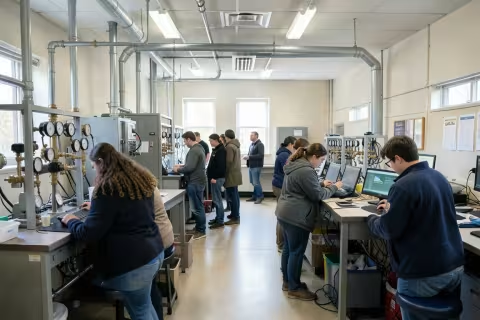
In a polytechnic, students reading gauges in a power-plant training lab full of pipes and valves

Mechanical & Manufacturing Engineering Technology

Compact Name
Mechanical
Program Type
Sort Name
Mechanical & Manufacturing Engineering Technology
Summary

The Mechanical & Manufacturing Engineering Technology department covers the MECH and MFGT subjects across several certificate, diploma and degree programs.

About the department

The Mechanical & Manufacturing Engineering Technology department covers the MECH and MFGT subjects. You will study mechanical design, manufacturing processes, and systems integration across our programs. Our curriculum blends applied theory with hands-on projects so you can solve real industrial problems.

Programs

Labs and workshops

Most of your practical work takes place in the Escarpment Building and the Tamarack Building. The Escarpment Building houses the department's engineering labs, where you will run simulations, test materials, and work with advanced manufacturing equipment. The Tamarack Building provides the shops and welding bays needed for fabrication and machining projects.

You must be 16 years old to enter the shops. If you are under 18, you will need a signed consent form from a parent or guardian. The department also offers three paid co-op work terms for eligible programs, so you can gain industry experience before you graduate.

Department leadership and contact

The department is led by Chair Douglas Ferreira. You can reach the department office in the Escarpment Building, or call 519-555-0170, ext. 5100. Office hours are Monday to Friday, 8:30 a.m. to 4:30 p.m.

Thumbnail
Image
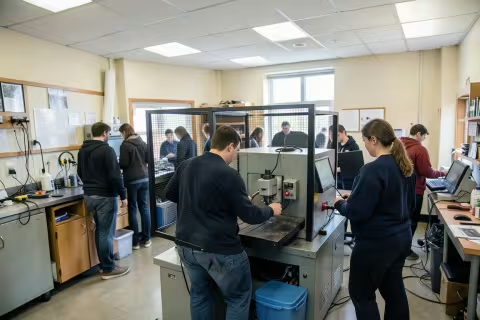
In a polytechnic, a student operating a CNC milling machine behind a safety screen

Electrical & Electronics Engineering Technology

Compact Name
Electrical
Program Type
Sort Name
Electrical & Electronics Engineering Technology
Summary

A full-time Ontario College Advanced Diploma at Wrenford Polytechnic's Benchlands Campus, focusing on circuit design, power systems, and electronics with three paid co-op work terms.

Program overview

Electrical & Electronics Engineering Technology is a full-time Ontario College Advanced Diploma offered at our Benchlands Campus. You will spend two and a half years building the technical skills needed to design, test, and maintain electrical systems and electronic circuits. The program prepares you for roles in industrial automation, power distribution, and electronics manufacturing. You can start in September or January.

What you will study

Your coursework is centred on the ELEC and ELNX subject groups. You will learn circuit analysis, control systems, microprocessors, and power electronics. You will also take courses in mathematics, physics, and technical communication to support your lab work. The program includes three paid co-op work terms, so you will graduate with real industry experience alongside your diploma.

Labs and facilities

Most of your classes and hands-on labs take place in the Escarpment Building on the Benchlands Campus. You will work in our electrical engineering labs and electronics testing rooms, using industry-standard equipment to build and troubleshoot circuits. You will also use the college's fabrication and machining shops for prototyping projects. The Escarpment Building is easily accessible by Wrenford Transit routes 3 and 7.

Meet your department chair

Helena Varga is the chair of the Electrical & Electronics Engineering Technology department. She oversees the curriculum, lab safety standards, and co-op placements for the program. If you have questions about course content, lab schedules, or department policies, you can reach her office during regular business hours.

How to reach the department

The department office is located in Room 312 of the Escarpment Building. You can call the department line at 519-555-0170, ext. 4310, or email the administrative team at [email protected]. For general admissions questions, contact the Admissions office at 519-555-0171.

Thumbnail
Image
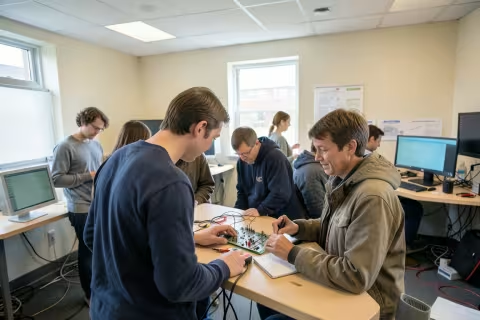
In a polytechnic, an instructor and student testing a circuit board with a multimeter

Environmental Technology Department

Compact Name
Environmental Technology Department
Program Type
Sort Name
Environmental Technology Department
Summary

The Environmental Technology Department delivers hands-on programs in environmental monitoring, water quality, and sustainability at our Benchlands Campus.

About the department

The Environmental Technology Department sits inside the School of Construction & the Environment. You will study with a team of instructors who bring real industry experience into the classroom. Chair Owen Pritchard leads the department and oversees all teaching, lab work, and co-op placements for our environmental programs. You will learn how to measure pollution, protect water sources, and manage waste in a way that keeps communities and industries running safely.

Programs

Facilities and labs

You will spend most of your time in the Kingfisher Building on the Benchlands Campus. The department runs dedicated environmental sampling labs and water quality testing rooms where you will practice using field instruments and laboratory equipment. You will also use shared workshop space in the Tamarack Building for equipment maintenance and safety drills. All labs follow strict safety rules, and you must follow privacy law when handling test data.

Contact

For questions about admission, course selection, or lab scheduling, reach out to the department office. You can call the main line and ask for the Environmental Technology desk.

Chair Owen Pritchard
Kingfisher Building, Room 305
519-555-0170, ext. 4400
Monday to Friday, 8:30 a.m. to 4:30 p.m.

Thumbnail
Image
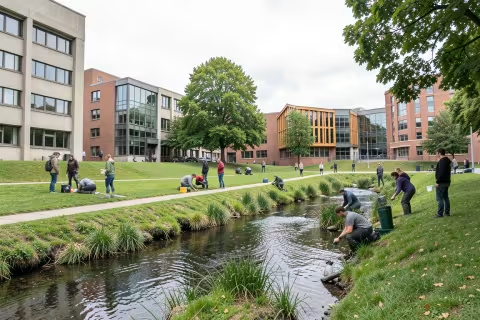
In a polytechnic, environmental students taking water samples at a creek edge in waders

Civil Engineering & Geomatics

Compact Name
Civil Engineering
Program Type
Sort Name
Civil Engineering & Geomatics
Summary

Prepare for careers in civil infrastructure, land surveying, and geographic information systems through hands-on programs and modern lab work.

About the department

The Civil Engineering & Geomatics department prepares students for careers in civil infrastructure, land surveying, and geographic information systems. You will work through hands-on projects that mirror real industry challenges, using the latest design and mapping tools. The department is led by Chair Nadia Benali.

Programs

Facilities and labs

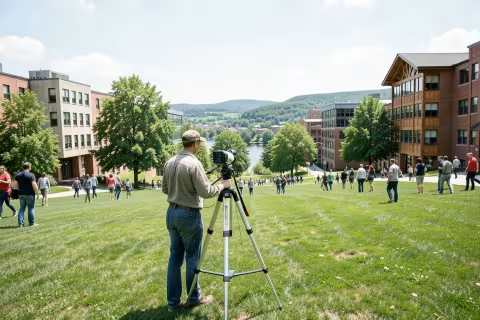
Students in the department use the Kingfisher Building for computer-aided design work and data analysis. Field surveys and mapping exercises take place at the Escarpment Building and the campus outdoor lab spaces. All students also have access to the Falls Library & Learning Commons for research and study.

How to reach us

The department office is in Room 212 of the Kingfisher Building. You can call the department at 519-555-0170, ext. 4301. For questions about admissions, visit the Admissions page or call 519-555-0171.

Thumbnail
Image
In a polytechnic, a surveying student behind a tripod-mounted instrument on a campus lawn