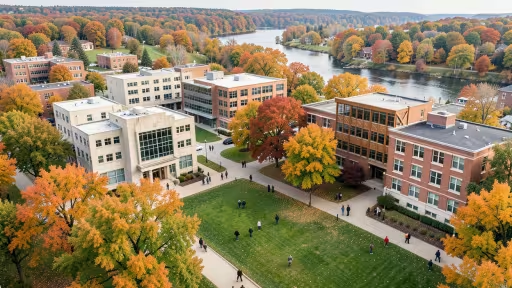
Assessing the campus roofline
Researchers in the School of Energy & Applied Engineering are evaluating the feasibility of expanding solar generation across Wrenford Polytechnic's two campuses. The study, led by faculty in the Power & Process Engineering department, examines whether the roofs at the Benchlands and Mercer Street locations can support additional photovoltaic capacity.
Ingrid Solberg, chair of the Power & Process Engineering department, notes that the college has been a leader in renewable energy education for years. Now the team wants to apply that knowledge to the buildings themselves.
"We teach our students how to design and maintain renewable systems, so it makes sense to use our own infrastructure as a living lab," Solberg says. "This study is about finding the real-world limits and opportunities right here on site."
What the study covers
The research team is mapping the available roof space at both the Benchlands Campus and the Mercer Street Campus. They are analysing structural load, shading from nearby buildings and trees, and historical energy consumption data to estimate how much electricity the panels could generate.
Key factors include:
- Roof orientation and pitch at the Tamarack Building, Escarpment Building, Kingfisher Building, and the Mill Building.
- Current and projected energy demand from high-consumption facilities like the Kestrel Centre and the Tamarack Building welding bays.
- Potential for battery storage integration to manage peak demand.
The study also looks at the cost of installation, maintenance requirements, and the expected lifespan of the equipment. The goal is to produce a clear report on whether a significant expansion is viable, and if so, what a phased rollout might look like.
Supporting the trade programs
The findings will directly inform the hands-on training for students in the Renewable Energy Systems graduate certificate and the School of Skilled Trades & Transportation. If the project moves forward, students in the Electrical & Mechanical Trades and Electrical Engineering Technology programs could gain experience installing and commissioning the new arrays.
The research is being conducted through the college's Research & Innovation office, which supports applied projects that solve practical problems for the institution and the wider community.
A summary of the study's findings will be shared with campus leadership later this year. If approved, the project could move into the planning stage for the 2027–28 academic year.
For more information on the program leading this research, see the Renewable Energy Systems program page.